
Historical operations perspective · Originally published 3 August 2026. Ontoo’s current focus is source-linked system context for engineers and coding agents. The article below discusses an earlier SRE application; it does not describe autonomous production changes as a current Ontoo capability.
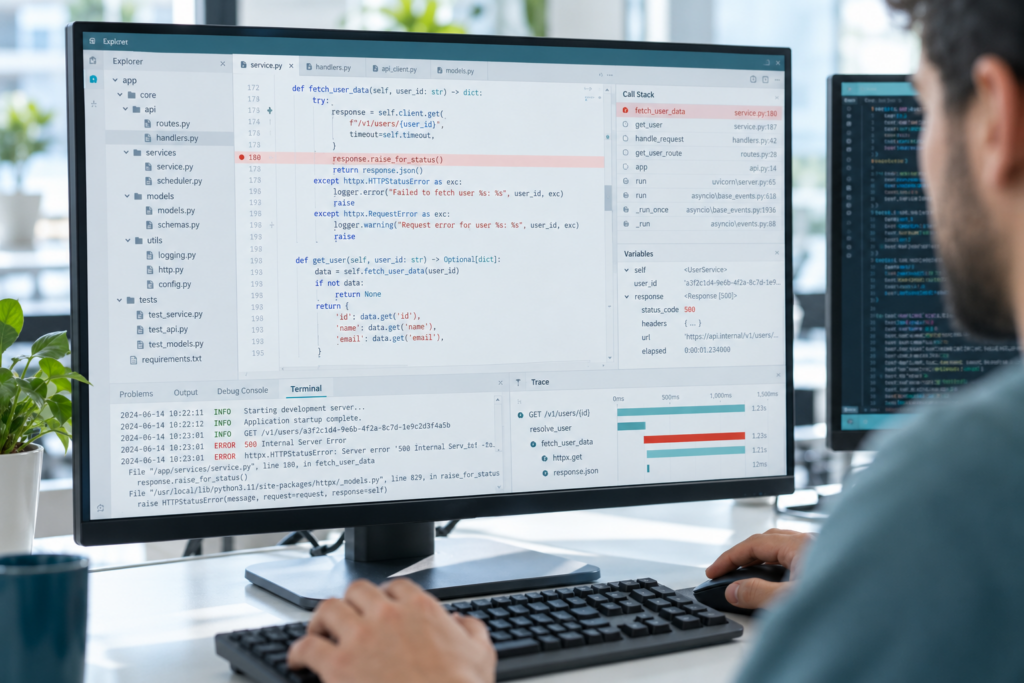
Cross-system root cause analysis starts by following an alert through the applications and dependencies behind it. Telemetry shows the symptoms. The surrounding architecture and the business flow help an investigator decide which paths to check first.
Modern enterprises have invested heavily in monitoring and observability. Operations teams collect enormous volumes of metrics, logs, traces, events, and alerts across their environments. Yet when a critical incident hits, experienced engineers still get pulled into war rooms, moving between tools and teams to answer a deceptively simple question: what actually caused this?
AI promises to change that. But moving from alert analysis to autonomous root cause investigation requires far more than giving an agent access to telemetry. It needs to understand the environment behind the signals.
Detection is only the beginning
Picture a bank seeing a sudden spike in failed payment transactions. Monitoring detects the failure rate and fires an alert. At nearly the same moment, a handful of other signals appear: API latency climbs, a downstream service starts throwing errors, a database shows higher load, a deployment went out earlier that day, and another team has opened a ticket on what looks like an unrelated service.
Which of these is the root cause? Which are symptoms? Which are noise?
This is where incident investigation gets hard — not because finding anomalies is difficult (modern monitoring is already good at that), but because understanding how they relate to each other is.
Telemetry tells you what happened
Logs, metrics, and traces are essential evidence. They show that a service failed, that latency spiked, that a request took a particular path, or that an infrastructure component got overloaded. But telemetry only describes observed behavior — root cause analysis requires reasoning about why that behavior occurred, and that reasoning often needs information the observability stack doesn’t have.
An engineer chasing the payment failures needs to know things like: which applications participate in the payment flow, which services depend on the component that’s failing, what changed right before the incident started, who owns the affected systems, what business processes rely on them, whether this has happened before, and what breaks downstream if this component goes out entirely.
That’s not observability data. That’s operational context.
The dependencies an investigator needs to trace
To investigate effectively, an agent has to understand how the pieces of the environment connect to each other. Say a payment API starts returning errors. The API itself might be perfectly healthy — the real problem could sit in a downstream authentication service, a database dependency, a message queue, an external provider, or a configuration change made somewhere else in the transaction flow entirely.
An engineer who knows the architecture knows where to look next. An agent needs that same instinct, built from an understanding of application-to-application dependencies, service-to-infrastructure dependencies, business-process-to-application relationships, upstream and downstream systems, recent changes and deployments, ownership, and the history of past incidents and known failure patterns.
Without those relationships, an agent can analyze signals. With them, it can investigate a system.
How to test a root cause hypothesis
Real incident investigations rarely move in a straight line. Engineers form a hypothesis, look for evidence, rule things out, discover a dependency they didn’t know about, and change direction. An effective AI agent has to work the same way.
Back to the bank: the agent starts with the payment application’s alert and pulls in the correlated errors from the other services. Based on the architecture map, it recognizes that two of those systems are downstream dependencies of the payment flow, not just correlated noise. It investigates further and finds that one of them had a configuration change pushed twenty minutes before the failures began. It checks whether the affected transaction paths actually route through that configuration — they do — and narrows the investigation to that single change. What started as five simultaneous signals resolves into one root cause.
The investigator needs a chain of evidence that connects the failing transactions to a dependency on their execution path. That chain also shows where another check is needed before the team acts.
Business context changes the meaning of an incident
Technical impact and business impact aren’t always the same thing. A service can show a high error rate while affecting only a minor internal workflow. Another can show a small technical degradation while disrupting a critical customer-facing process.
For an SRE agent operating inside a financial institution, that distinction matters. An incident affecting payment authorization may demand an entirely different response than one affecting a noncritical internal tool, even if the technical symptoms look identical on a dashboard. The agent needs to connect technical dependencies to business processes so it can answer not just what is failing, but what that failure actually affects — which becomes critical when prioritizing investigations and weighing remediation options.
Resolution requires even more context
Finding the likely root cause is only part of the job. The next question is what to do about it. An agent might conclude that rolling back a recent deployment is the right fix — but before it recommends that, it needs to understand what else depends on the new version. A restart might resolve one service while interrupting another. A configuration change might fix the immediate issue while quietly creating a new one downstream.
The closer an AI system gets to taking action, the more its understanding of dependencies and consequences matters. This is why agentic SRE can’t be reduced to an LLM reading logs — the agent needs a continuously current understanding of the environment surrounding the incident.
From observability to investigation
To follow an alert to its likely cause, connect the affected application to its dependencies, recent deployments, and the business flow. The System Atlas explains how Ontoo represents those relationships for engineers today.
Observability provides the signals. Context gives those signals meaning. Reasoning connects the evidence. Action turns the conclusion into an operational outcome.
That’s what lets an AI system move past explaining an alert and start participating in the investigation itself.